Confirm the rule before changing the board
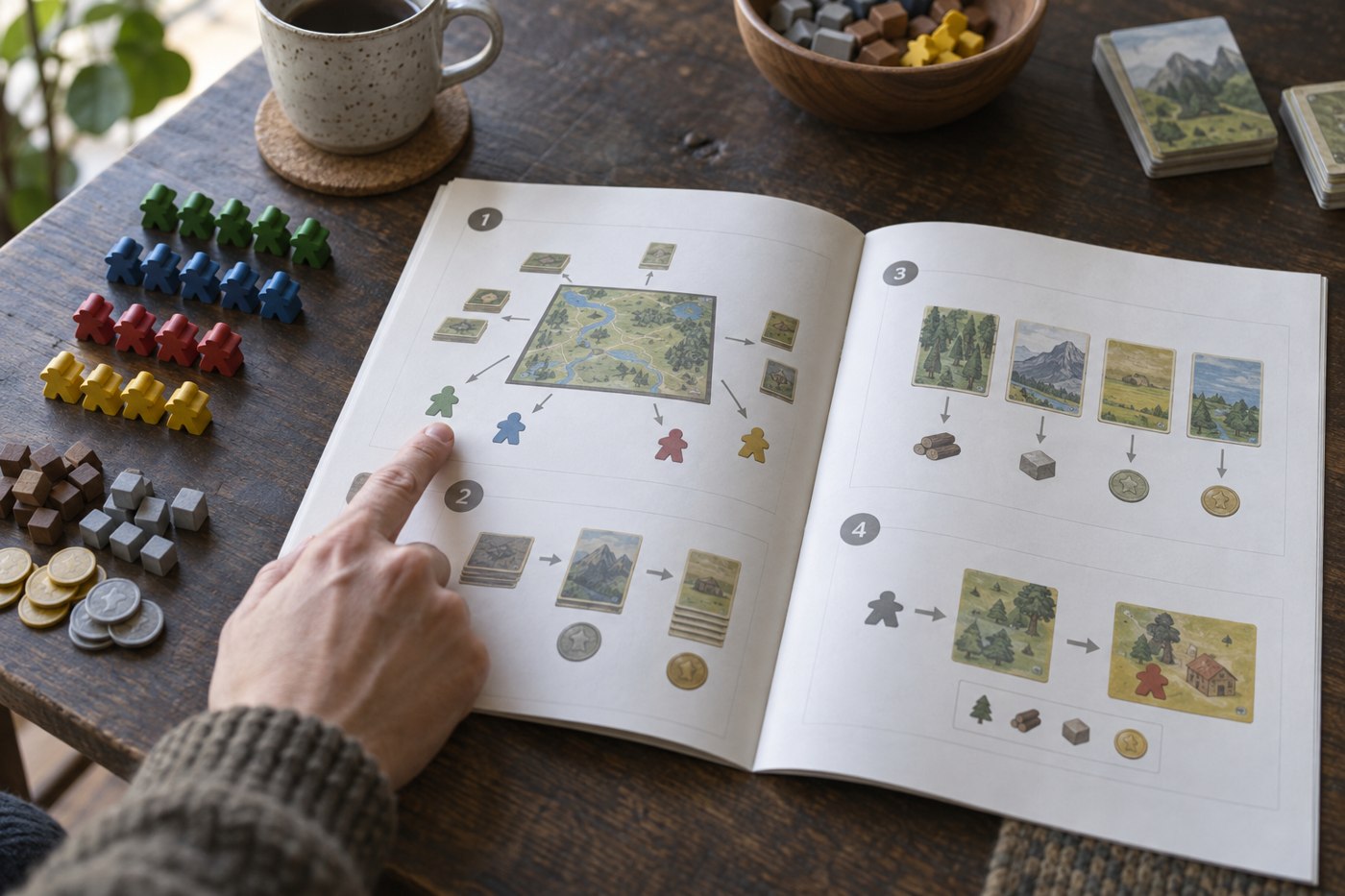
Pause at a stable point and read the relevant passage in full. Check the edition, any special card text and the timing of the effect. A rule remembered from another game or an older printing can sound convincing while being irrelevant. If the printed text remains ambiguous, separate what is confirmed from what still needs clarification.
Describe the mistake neutrally. Saying that the group has been drawing one card too few gives everyone a concrete problem to solve. Blaming the teacher or the last player to benefit adds tension without restoring the correct position. First games involve a shared learning process, even when one person prepared the explanation.
Decide whether an exact repair is possible
A recent missed payment may be easy to correct if the player still has the required resources and nothing depended on the total. Move the omitted payment now and verify that the action was legal at the time. Do not simply subtract it if doing so would reveal that the player could never have afforded the move; that needs a fuller rewind or another agreed response.
Reconstruction becomes less reliable after cards are drawn, dice are rolled or opponents make decisions in response. You can move a piece back, but you cannot remove knowledge of a revealed card. Consider whether the new information would have changed the original choice. An apparently neat rewind can create a different advantage rather than undoing the first one.
Distinguish accounting errors from changed decisions
An omitted fixed reward can sometimes be restored exactly by checking visible records. A missed option is harder: nobody can know with certainty which action a player would have chosen earlier. Avoid awarding an imagined best outcome as compensation. That gives the repaired player information they did not have when the decision belonged to them.
If the error affected everyone repeatedly, a complete historical recalculation may be impractical. You might agree to use the correct rule from the next clear boundary and treat the session as a learning game. State that this preserves playability rather than producing a fully comparable score. Recording the result as if the game had been played correctly would conceal a meaningful difference.
Choose the scope together
Offer a small number of concrete options: correct the immediate state, rewind a known sequence, continue correctly from now, or restart. Explain the time cost and the information problem with each. Let players who were disadvantaged speak before the most confident person settles the matter. Agreement is easier when the options refer to the actual position rather than abstract ideas of fairness.
A restart makes sense when the missed rule defines the central challenge and little time has passed. It is less appealing when the error is minor and an hour of enjoyable play would be discarded. Ask whether the group still wants the experience the current game can provide. Finishing a flawed learning session can be a reasonable choice if everyone understands its limits.
Prevent the same miss next time
Add a brief reminder beside the relevant phase or on a removable note in the box. Write the real rule and its page reference, not a long account of the disagreement. If a homemade player aid caused the problem, correct every copy. Leaving one old version in circulation can reproduce the error at the next table.
Before the next session, mention the correction during the explanation and demonstrate it once. Avoid repeatedly bringing up who benefited last time. The useful legacy of the mistake is a clearer procedure. If you keep scores, mark the earlier session as having used a mistaken rule so that later comparisons do not become confusing.
Check whether the apparent disadvantage changes the practical repair. A missed reward that cannot now be spent may not restore the same opportunity as receiving it earlier. Explain that limitation openly rather than declaring the accounts balanced solely because the final resource totals match.