Separate your rules from the opponent's rules
Start by identifying which ordinary rules still apply to the automated side and which are replaced. It may not collect resources, pay costs or satisfy prerequisites in the same way you do. Those shortcuts are often part of the design, not permission to make similar exceptions for your own turn.
Keep its pieces and reference material in a distinct area. Use the labels printed in the solo rules rather than treating every token as equivalent to your personal supply. If the opponent gains points directly where a human would build an engine, track those points as instructed instead of inventing an engine for it.
Read the whole turn procedure once
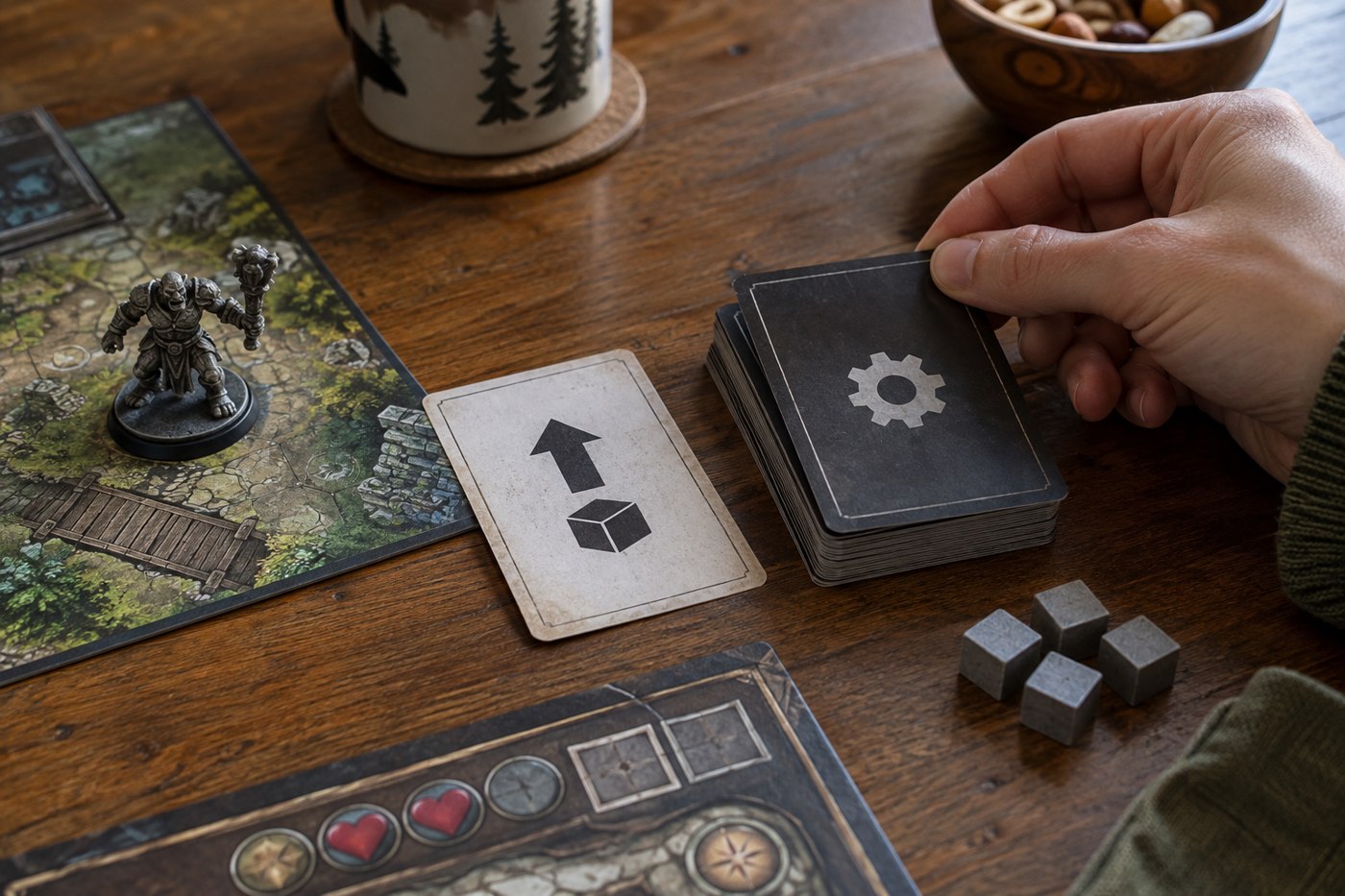
Before resolving the first instruction card, learn the sequence: when to draw, which part of the card applies, how to choose a target and what cleanup follows. A card may serve several functions at different times. Looking at the wrong section can produce a plausible but incorrect action.
Work through one example with the rules open. Move a temporary marker through the steps if that helps. Reset the example before starting the actual game so the demonstration does not alter the deck order or supply. Knowing where the procedure begins and ends is more useful than memorising every icon immediately.
Follow priorities in order
Many automated systems use a hierarchy to choose among legal targets. For instance, an illustrative opponent might prefer the region with the most resources, then the nearest such region, then the lowest printed number. Apply the first test, retain only tied candidates and continue to the next test. Do not jump to the final tiebreaker while a higher-priority distinction remains.
When no target qualifies, use the published fallback. The opponent might skip an action, choose another category or receive a substitute reward. Do not choose whatever seems strategically best on its behalf unless the rules explicitly ask you to do so. Adding your judgement can unintentionally change difficulty and make repeated plays inconsistent.
Keep a note of a frequently missed priority beside the reference, but do not replace the full procedure with an inaccurate shortcut. A simplified reminder should point you to the correct rule, not silently omit exceptions.
Understand what information it uses
An automated opponent may react only to public board conditions, or it may be allowed to inspect information a human opponent would not know. Follow the stated procedure. Do not protect a hidden card from the system if the rule requires it to be checked, and do not reveal extra information merely to make its action easier to choose.
Also distinguish random selection from priority selection. If a rule says to draw a card to determine direction, choose randomly as instructed rather than selecting the direction that seems most challenging. The uncertainty is part of the opponent's behaviour. Replacing it with deliberate hostility creates a different game.
Track its timing and scoring separately
Know when the opponent acts relative to your turn, when it scores and what can trigger the end. It may not receive the same number of actions or use the same final scoring formula. Missing one regular scoring step can matter more than making a small movement error.
Use the supplied markers to show completed actions or scoring windows where available. Resolve gains immediately unless the rules defer them. If you notice an omission, reconstruct it only when the necessary information is reliable; otherwise record the uncertainty and use a consistent correction rather than pretending the final result is exact.
Adjust difficulty through the published settings
An automated rival may offer difficulty levels that change its deck, income, points or decision priorities. Choose the recommended introductory setting while learning. A setting that looks easy may still provide enough pressure while you are managing two rule systems.
Do not respond to a surprising loss by making ad hoc changes to its behaviour. First check setup, action timing and scoring. If those are correct, use an official easier configuration next time. Similarly, an easy win may reflect a missed opponent step rather than a need to jump several levels immediately.
Let familiarity reduce the work
After several rounds, recurring instructions become easier to recognise. Continue checking unusual cases rather than resolving them from a vague memory. A short pause preserves the design's consistency and is usually quicker than repairing an uncertain state later.
After the game, note one rule that slowed you down and where its answer appears. Over time, this creates a small personal reference for the parts you actually forget. The aim is to spend less effort decoding the opponent while preserving the procedure that makes it a meaningful challenge.